
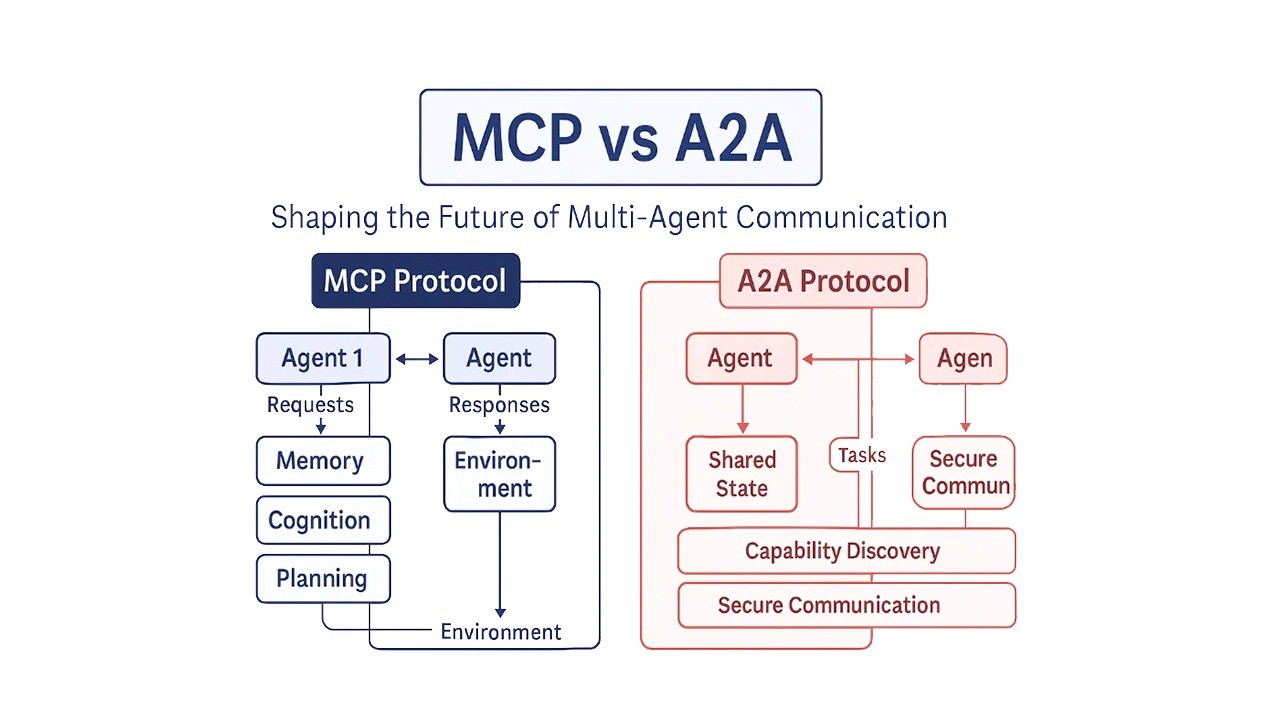

If you’ve been following the story about artificial intelligence and digital agents, you’ve probably come across the terms MCP and A2A. You might still not be clear on what the difference actually is — and you’re not alone! Here’s the simplest possible explanation:
What MCP and A2A Are
- MCP (Multi-Agent Communication Protocol)
This is like agents communicating through a “central translator”. Every agent sends a request, the central system processes the information, remembers context, plans, and sends back a response. Think of it like calling customer support: you send a query, the operator checks everything, then replies. - A2A (Agent-to-Agent Protocol)
This is direct communication between two agents — no intermediary. They share information and tasks directly, quickly and efficiently, like colleagues in an office deciding who does what without involving a manager.
Everyday Examples
Example 1: Banking Help
- MCP: You come into a bank, explain what you need, the teller asks a colleague, then gives you an answer — everything goes through the central system.
- A2A: You text or call your bank advisor directly — the answer is faster and more direct.
Example 2: Event Organization
- MCP: The manager sends tasks to each team member, tracks progress, and gives instructions.
- A2A: Team members communicate with each other, share information, assign tasks, and help each other without the manager’s involvement.
Why the Difference Matters
MCP is great when you need centralized control, consistent memory of past decisions, and safety/traceability. But A2A opens a completely new dimension — it lets agents (digital assistants) negotiate, coordinate, and learn from each other independently.
With MCP, product development feels like a traditional company with a CEO at the top. With A2A, everything feels more like a “smart network” where every member contributes, and the whole network constantly grows and evolves.
This shift means:
- Faster innovation — new capabilities can connect and emerge quickly, without waiting for complete redesigns.
- Greater flexibility — products can easily adapt to different customer or market needs.
- More personalization — each user can get a tailored experience because agents recognize individual requirements.
- Lower development & maintenance costs — instead of constantly repairing one huge system, you can improve or replace just the part that needs it.
- New opportunities to connect to other businesses — agents can communicate directly and securely with outside digital services and markets.
Future Vision
Future products, Purić concludes, won’t be static software packages anymore — they will be living, adaptive systems that are always ready for change. Businesses that embrace this new way of thinking will be ahead of the competition — faster, more agile, and closer to their users’ real needs.
If you want, I can also explain how MCP and A2A protocols work in technical terms or give examples of how companies could practically implement them — just let me know!